Hindu Darshan
॥ वेदाः सर्वविद्याः मूलम् ॥
ज्ञानं परम ध्येयम्। वेदाः ज्ञानस्य प्रकाशकाः।
The Vedas are the source of all knowledge.
Knowledge is the highest goal. The Vedas are the illuminators of knowledge.
Hindu Philosophy
षड्दर्शन
Hinduism is not a single philosophy but a vast, pluralistic tradition of inquiry. The six orthodox schools (Shad Darshanas) — Samkhya, Yoga, Nyaya, Vaisheshika, Mimamsa, and Vedanta — each offer a complete, internally consistent worldview, all rooted in the authority of the Vedas.

“ईशावास्यमिदं सर्वं — All this is enveloped by the Lord”
Advaita Vedanta
अद्वैत वेदान्त
Non-dualism — All is One Brahman
The highest philosophical tradition asserting that Atman (Self) and Brahman (Ultimate Reality) are absolutely identical. The phenomenal world is Maya — apparent superimposition on the one undivided Consciousness.
Brahma Satyam, Jagat Mithya, Jivo Brahmaiva Na Para
“Brahman is real, the world is illusory, the individual self is none other than Brahman”
— Adi Shankaracharya
Dvaita Vedanta
द्वैत वेदान्त
Dualism — God and Soul are eternally distinct
Vishnu is the supreme independent reality; souls and matter are eternally real but entirely dependent on Him. Moksha is living in the blissful presence of Vishnu, not merger.
Harir Vishvam Vyapnoti
“Hari (Vishnu) pervades the entire universe”
— Madhvacharya
Vishishtadvaita
विशिष्टाद्वैत
Qualified Non-dualism
Brahman is one, but souls and matter are real and constitute the 'body' of Brahman. The individual soul is a real mode of Brahman — neither completely merged nor completely separate.
Sarva Khalu Idam Brahma
“All this is indeed Brahman”
— Ramanujacharya
Samkhya
सांख्य
Cosmic dualism of Purusha & Prakriti
The oldest systematic philosophy of India. Reality consists of two eternal principles — Purusha (Consciousness) and Prakriti (Matter). Liberation is realising that Purusha is eternally free.
Viveka-khyaati
“Discriminative knowledge between Purusha and Prakriti leads to liberation”
— Maharishi Kapila
Yoga Darshana
योग दर्शन
The science of mind-cessation
Patanjali's Yoga Sutras systematise the eight-limbed path (Ashtanga Yoga) as a practical means to still the fluctuations of the mind and realise the Purusha in its pure form.
Yogas Chitta-Vritti-Nirodhah
“Yoga is the cessation of the modifications of the mind-field”
— Maharishi Patanjali
Nyaya
न्याय
Logic & epistemology of liberation
The school of logic and analytical philosophy. It establishes pramanas (sources of valid knowledge) and argues that the existence of God (Ishvara) can be proven through rational inference.
Pramana-janya-Jnaana
“Knowledge arising from valid means of cognition”
— Gautama Muni
Vaisheshika
वैशेषिक
Atomistic naturalism & cosmology
The earliest atomic theory in history. All matter is composed of eternal, indestructible atoms (paramanu) of earth, water, fire, and air. The soul is omnipresent, eternal, and distinct from matter.
Vishesha-jnaanam Mokshasya Sadhanam
“Knowledge of the particular (distinguishing features) is the means to liberation”
— Maharishi Kanada
Mimamsa
मीमांसा
Vedic exegesis & ritual theology
Declares the Vedas as the highest authority (Apaurusheya — not authored by any person). It focuses on the correct interpretation of Vedic injunctions for performing rituals (yajna) to attain dharma.
Dharmo Vedena Pratipaaditah
“Dharma is established by the Vedas”
— Maharishi Jaimini
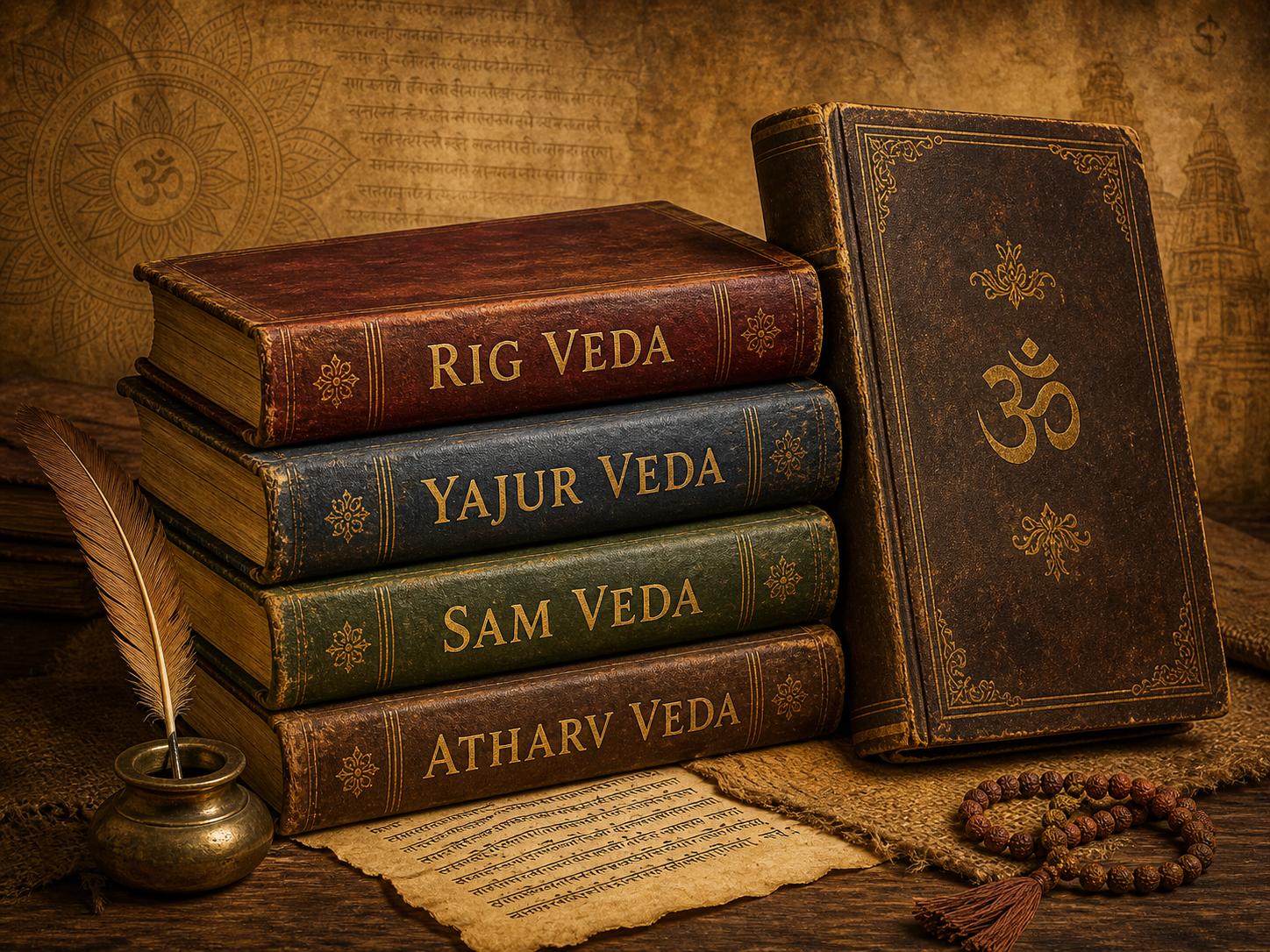
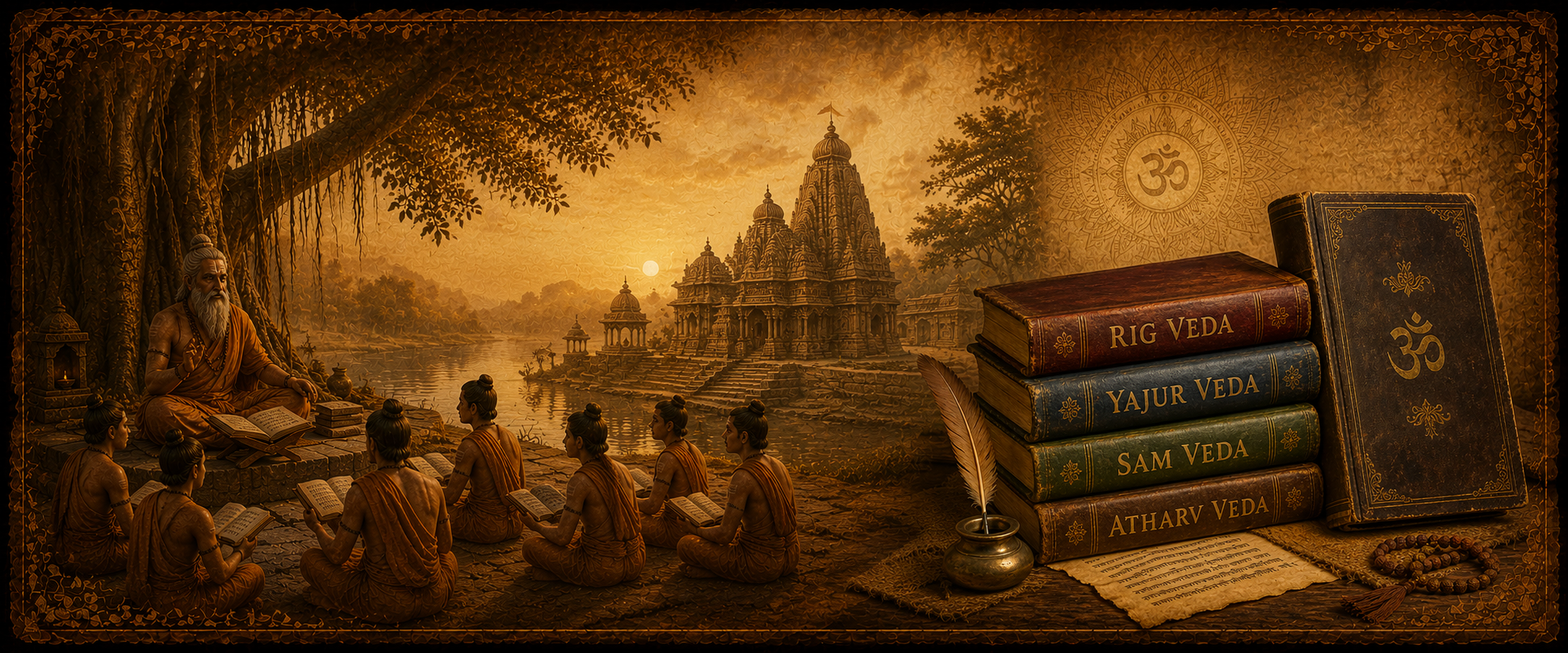
The Vedas — śruti (that which is heard) — revealed to ancient rishis in deep samadhi
The Four Vedas
चतुर्वेद
The Vedas are the eternal, self-revealed (Apaurusheya) scriptures of Sanatana Dharma. They are Shruti — “that which is heard” — revealed to ancient rishis in the depths of samadhi and transmitted orally across thousands of years with extraordinary precision.
Each Veda has four sections: Samhitas (hymns), Brahmanas (ritual treatises), Aranyakas (forest texts), and Upanishads (philosophical dialogues). Together they form the complete map of knowledge — from material prosperity to ultimate liberation.
Rigveda
ऋग्वेद
Veda of Praise
10,552 mantras
The oldest scripture in the world and the first of the four Vedas. A collection of 1,028 hymns (suktas) addressed to the Vedic deities, composed in sublime Sanskrit meter. Its Purusha Sukta and Nasadiya Sukta are among the most profound philosophical texts ever written.
अग्निमीळे पुरोहितं यज्ञस्य देवमृत्विजम्।
“I praise Agni, the household priest, the divine minister of the sacrifice…”
Samaveda
सामवेद
Veda of Melodies
1,875 mantras
The Veda of songs and melodies — considered the root of Indian classical music. Most of its verses are drawn from the Rigveda but set to specific melodies (saman) for liturgical chanting during the Soma sacrifice. It is said to be Krishna's favourite: 'Among Vedas I am Samaveda.'
सामवेदोऽस्मि यज्ञानां ज्ञानमस्मि विभूतयः।
“Among the Vedas I am the Sama Veda — Bhagavad Gita 10.22”
Yajurveda
यजुर्वेद
Veda of Ritual Formulas
3,988 mantras
The priest's manual — containing prose mantras (yajus) to be muttered by the adhvaryu priest during the performance of yajna (sacred fire rituals). Divided into Krishna (Black) and Shukla (White) Yajurveda. Its 40th chapter, the Ishopanishad, is one of the most celebrated Upanishads.
ईशा वास्यमिदं सर्वं यत्किञ्च जगत्यां जगत्।
“All this — whatever exists in this moving world — is enveloped by the Lord”
Atharvaveda
अथर्ववेद
Veda of the Atharvans
5,977 mantras
The fourth and final Veda — a compendium of healing formulas, protective charms, philosophical hymns, and cosmological speculations. Its Prithvi Sukta (Hymn to the Earth) is the world's first environmental poem. The Atharvaveda contains the seeds of Ayurveda, astronomy, and statecraft.
माता भूमिः पुत्रोऽहं पृथिव्याः।
“The Earth is my mother, and I am her son”
The Upanishads
उपनिषद्
Upanishadmeans “sitting near” — the intimate transmission of supreme wisdom from teacher to student at the feet of the guru. The 108 Upanishads are the end-portions (Vedanta) of the Vedas, containing the philosophical core of all Hindu thought.
Their central teaching: the identity of Atman (individual Self) with Brahman (Universal Consciousness). The Mahavakyas — the great sayings — crystallise this truth in four unforgettable formulas.
प्रज्ञानं ब्रह्म
Rigveda
अहं ब्रह्मास्मि
Yajurveda
तत्त्वमसि
Samaveda
अयम् आत्मा ब्रह्म
Atharvaveda

“तत्त्वमसि — Thou art That” — Chandogya Upanishad
Brihadaranyaka Upanishad
बृहदारण्यक उपनिषद्
Belongs to: Shukla Yajurveda
The largest and one of the oldest Upanishads. Contains the great dialogues of Yajnavalkya — including his famous conversation with Maitreyi on the immortal Self. The Neti-Neti (not this, not this) method of understanding Brahman originates here.
Mahavakya
अहं ब्रह्मास्मि
“I am Brahman”
Chandogya Upanishad
छान्दोग्य उपनिषद्
Belongs to: Samaveda
Contains the profound teaching of Uddalaka to his son Shvetaketu, culminating in 'Tat Tvam Asi' — the identity of the individual soul with Brahman. Also includes the story of Satyakama Jabala and the meditation on the syllable Om.
Mahavakya
तत्त्वमसि
“Thou art That”
Mandukya Upanishad
माण्डूक्य उपनिषद्
Belongs to: Atharvaveda
The shortest yet most profound — just 12 verses. It analyses the four states of consciousness (waking, dream, deep sleep, and the fourth — Turiya). Gaudapada's Karika upon this Upanishad established Advaita Vedanta.
Mahavakya
अयम् आत्मा ब्रह्म
“This Self is Brahman”
Katha Upanishad
कठ उपनिषद्
Belongs to: Krishna Yajurveda
The story of young Nachiketa who goes to Yama (Death) and receives the supreme knowledge of the immortal Atman. One of the most dramatic and poetic Upanishads — the source of the famous verse on the razor's edge path to liberation.
Mahavakya
न जायते म्रियते वा
“It is not born nor does it die”
Isha Upanishad
ईश उपनिषद्
Belongs to: Shukla Yajurveda
The shortest complete Upanishad — 18 verses of extraordinary depth. It reconciles action and renunciation, declaring that one can live in the world with total non-attachment. Mahatma Gandhi said he could derive all ethics from this single Upanishad.
Mahavakya
ईशावास्यमिदं सर्वम्
“All this is enveloped by the Lord”
Mundaka Upanishad
मुण्डक उपनिषद्
Belongs to: Atharvaveda
Distinguishes between Para Vidya (supreme knowledge of Brahman) and Apara Vidya (lower knowledge of sciences). Contains the beautiful metaphor of two birds on the same tree — one eating, one only witnessing — representing Atman and Jiva.
Mahavakya
सत्यमेव जयते
“Truth alone triumphs”
अष्टोत्तरशतोपनिषद्
There are 108 Upanishads in total. The 10 Mukhya (principal) Upanishads — chosen by Adi Shankaracharya — are regarded as the most authoritative.

700 Shlokas · 18 Chapters
“सर्वधर्मान्परित्यज्य मामेकं शरणं व्रज”
“Surrender unto Me alone” — Gita 18.66
Bhagavad Gita
भगवद्गीता
The Bhagavad Gita — “Song of God” — is a 700-verse dialogue between the warrior-prince Arjuna and his charioteer, Shri Krishna, on the battlefield of Kurukshetra. It is embedded in the Mahabharata (Bhishma Parva, chapters 23–40) and constitutes the single most important text in Hindu philosophy.
In 18 chapters, Krishna instructs Arjuna on Karma Yoga, Jnana Yoga, Bhakti Yoga, and Raja Yoga — the four paths of liberation — resolving the eternal crisis of duty, desire, and the nature of the Self.
Key Shlokas
18 Chapters — अष्टादश अध्याय
Sacred Texts
धर्मग्रन्थ
Beyond the Vedas and Upanishads, Sanatan Dharma possesses the richest literary heritage in human history — the Itihasas (epics), the 18 Mahapuranas, the Dharmashastra, the Nitishastra, and the philosophical sutras. Together they form an ocean of knowledge spanning theology, cosmology, ethics, law, medicine, music, and statecraft.

“यतो धर्मस्ततो जयः — Where there is Dharma, there is victory”
Ramayana
रामायण
The Adi Kavya — the first poem. The timeless epic of Shri Rama, the ideal human being (Maryada Purushottama), whose life embodies dharma, devotion, courage, and compassion. A mirror of ideal relationships — husband, son, king, friend, brother.
Mahabharata
महाभारत
The longest epic in human history. The great war of Kurukshetra between Pandavas and Kauravas is the backdrop for the most profound exploration of dharma, karma, duty, and the human condition. Contains the Bhagavad Gita, Vishnu Sahasranama, and countless treasures.
Bhagavata Purana
भागवत पुराण
The Mahapurana that speaks of the glory of Bhagavan Vishnu through his avatars and devotees. Its 10th Skandha narrates the divine life of Krishna. Considered the ripened fruit of the Vedic tree — the essence of all Vedantic wisdom in narrative form.
18 Mahapuranas
अष्टादश महापुराण
The eighteen great Puranas — including Vishnu, Shiva, Devi, Brahma, Padma, Narada, Garuda, and more — constitute the encyclopaedia of Hindu religion, cosmology, genealogy, and dharma. Each Purana presents the Vedic teachings through narrative, myth, and scripture.
Yoga Sutras
योग सूत्र
The definitive text on Yoga — 196 terse aphorisms that systematise the entire science of consciousness. Defines yoga as 'Chitta Vritti Nirodhah' and outlines the eight-limbed path (Yama, Niyama, Asana, Pranayama, Pratyahara, Dharana, Dhyana, Samadhi).
Arthashastra
अर्थशास्त्र
The ancient Indian treatise on statecraft, economic policy, military strategy, and dharmic governance. Written by the brilliant minister Chanakya, it reveals that ancient India had a sophisticated understanding of administration, diplomacy, and economics centuries ahead of the West.
सा विद्या या विमुक्तये
“That alone is knowledge which leads to liberation” — Vishnu Purana